
Calcasieu Parish Directory Runs
The historical shelf begins with a Lake Charles city directory described by the parish library as the city's first. Later runs survive in an uneven sequence, so searching one year is rarely enough. The online guides do not reliably name each publisher. That gap matters: never assign an imprint such as Polk merely because it is common elsewhere. Record the title page when it can be checked, along with the year, page, and repository.
| Collection | Years | Where held | Access |
|---|---|---|---|
| Lake Charles City Directory | 1895-1896 | Southwest Louisiana Genealogical & Historical Library | Accessibility PDF, photocopy, and microfilm |
| Lake Charles city directories | 1911-1913, 1915, 1917, 1921, 1925 | St. Louis County Library guide | Microfilm lead; verify local access |
| Lake Charles city directories | 1927-1931, 1934, 1936-1939 | Library guides and NARA lead | Microfilm or archive research |
| Lake Charles city directories | 1941-1943, 1945-1950, 1952-1960 | St. Louis County Library guide | Microfilm; gaps remain |
Those gaps are part of the evidence. A person absent in 1914 or 1951 may simply fall between known runs. The library's national database links can add access, but they do not promise that every Calcasieu Parish city directory year has been digitized.
Lake Charles First Directory
The 1895-1896 Lake Charles directory scan is the key pre-fire starting point. The source note identifies it as a copy of the first directory and says the library keeps photocopy and microfilm copies at its Pujo Street branch. It can preserve a name or old street form that does not appear in a modern parcel search.
This volume predates the 1910 fire. Its value lies in the date attached to each printed clue, not in proof of continuous residence. Save an image of the page and title information, then compare the person or address with another dated source. The accessible text did not expose a reliable publisher or abbreviation key, so those details should be read from the volume rather than guessed.
Calcasieu Parish Genealogy Room
The Southwest Louisiana Genealogical & Historical Library is at 411 Pujo Street in Lake Charles. Its genealogy pages list 337-721-7110, genstaff@calcasieulibrary.org, weekday hours from 9:00 a.m. to 6:00 p.m., and every third Saturday from 9:00 a.m. to 5:00 p.m. Check the current page for closures before a visit.
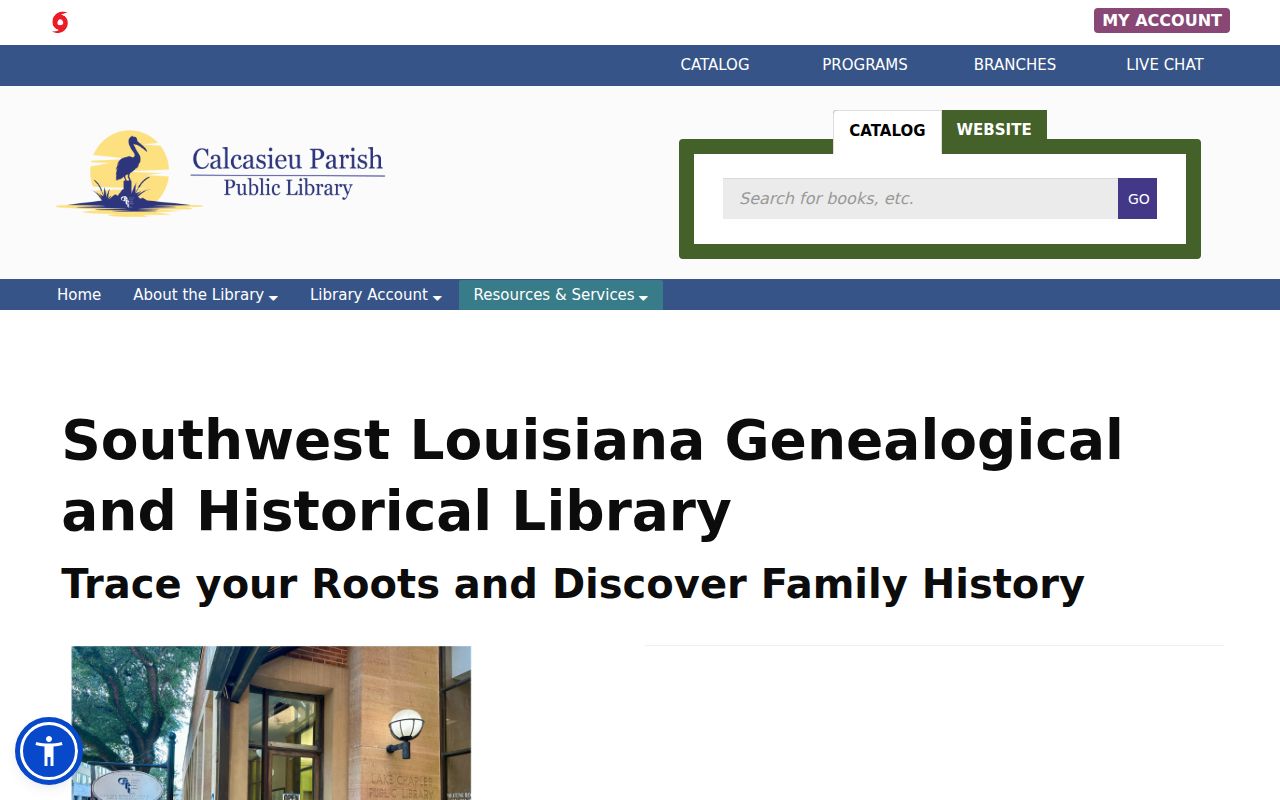
Staff can help locate books, periodicals, microfilm, family files, cemetery and church records, courthouse documents, military sources, land records, and research guides. The named local collections include the Maude Reid Scrapbook Index, History of Mossville, C-GOV history items, and a yearbook digitization project. Calling ahead is wise when a needed item is on film or tied to licensed database access.
Read Calcasieu Directory Clues
A city directory entry is a dated lead. Depending on the volume, it may contain a name, initials, spouse or household note, street address, business, trade, telephone line, or status mark. The inspected scan did not support claims about which exact marks appear in 1895-1896. Photograph the key before expanding an abbreviation, and keep the printed spelling even when it seems wrong.
| Name line | Copy the full form, initials, title, and nearby same-surname entries. |
|---|---|
| Street line | Record number, street spelling, direction, and suffix exactly as printed. |
| Household note | Treat a spouse, widow, boarder, or owner mark only as the volume defines it. |
| Work or business | Use the organization as a second search term, not as proof of identity. |
| Page context | Save the page, directory year, title page, and abbreviation key. |
- Criss-cross directory
- A volume or section arranged by street or telephone number instead of surname. No separate Calcasieu run was confirmed.
- Householder index
- An address-led list that may name the person associated with a dwelling.
- Abbreviation key
- The volume's own legend for short forms and symbols. It controls how an entry should be read.
Calcasieu Names Beyond Directories
The library genealogy collections extend a city directory result with an obituary index, newspapers, yearbooks, cemetery sources, and family material. Its obituary form accepts surname, first name, middle name, and death date. Advanced fields include date of birth and cause of death. An index hit is a newspaper lead, not a certified death record.
Coverage differs by publication and vendor. American Press full text begins in 2002, with digitized editions from 2022. Southwest Daily News text starts in 2001. Other tools include NewsBank, HeritageHub, Newspapers.com content through 1922, and in-library NewspaperArchive access. Some remote tools require a library card. Record the paper, issue date, page or image status, and database so another researcher can retrace the result.
Calcasieu Parish Archive Partners
When the city directories stop, regional collections may carry the name forward. McNeese State University's Frazar Memorial Library describes more than 300 collections spanning about 5,500 linear feet. Maps, early city papers, photographs, newspapers, school and organization files, business records, personal papers, oral histories, and local books can connect a person to a dated place.
The Calcasieu Historical Preservation Society adds building histories, local timelines, Landmark Awards, and preservation context. It is not a resident register, but its place-based clues can explain an address or civic group found in a volume.

For cemetery work, the FamilySearch catalog describes a Calcasieu Parish compilation prepared in 1966 and filmed in 1971. Image access can require an account or affiliate library. The Louisiana Cemetery Board supplies cemetery addresses and contacts, not a complete grave-name search.
Why Calcasieu Records Break
Calcasieu Parish was formed from St. Landry Parish in 1840, before it had a courthouse. Early meetings were held in Arsene LeBleu's home. Private papers, church files, cemeteries, and records held beyond today's parish lines can therefore matter for the earliest names.
The 1910 Lake Charles fire later destroyed or scattered records. The Clerk's archive uses separate pre-fire labels, and one displayed "Marriage Before Fire" date range appears anomalous. Preserve the label and ask the Clerk to verify the book. Do not silently correct it.
| 1840 | Calcasieu Parish was created from St. Landry Parish, before a courthouse was available. |
|---|---|
| 1895-1896 | The first Lake Charles directory provides a dated pre-fire name and address layer. |
| 1910 | The Lake Charles fire explains destroyed, scattered, and separately labeled archive material. |
| 1911-1960 | Surviving directory runs continue on microfilm with gaps between listed years. |
| 2026 | The pre-1910 Loftin-Levingston Title Records collection was announced and displayed at McNeese. |
A July 2026 report described McNeese's Loftin-Levingston Title Records, with maps, property, cemetery, industry, and family-name material from the 1840s forward across five parishes. The reported targets were a fall 2026 archive and a public website in 2028. Those dates describe plans, so check current McNeese access before relying on them.
Trace Calcasieu Family History
A careful family-history search moves both forward and backward from one solid result. Keep each city directory citation separate so changes are visible rather than blended into one life story.
- Find the nearest available year by surname, address, or business, and copy the entry exactly.
- Check the next earlier and later surviving runs. Note new initials, address forms, spouse notes, and business links.
- Pair the dated entry with an open federal census. The 1950 schedule is the latest routinely public census as of 2026.
- Use the obituary index and newspaper coverage to test a death, relative, or last-address lead.
- Take an address question to the Assessor and Clerk deed records, or use the Calcasieu Parish street directory workflow for modern address-keyed sources.
Disappearance has several causes: death, a move, a missed publication year, a spelling change, an unlisted household, or a boundary label that changed. Search initials and married names, inspect nearby alphabetical entries, and retain terms such as Mossville or Bunche Village when the source uses them. A second dated record is what turns a plausible match into a sound conclusion.