
Dated Sources for Calcasieu Previous Residents
One Calcasieu Parish address can pass through several record eras. Begin near the date being researched. Current parcels and recent deeds work well for a modern chain, while directories, census schedules, archive books, obituaries, and house-history collections carry the address farther back. Each source records a different event, so no single row proves continuous residence.
| Source | Years It Covers | Where Held | What It Shows |
|---|---|---|---|
| Clerk conveyance eSearch | 1987-present | Online account or Clerk office | Indexed transfers with vendor and vendee |
| Clerk archive indexes | Series identified for 1903-1958 | Clerk archive and scanned books | Earlier names and instrument continuity |
| Lake Charles directories | 1895-1896 and listed runs through 1960 | Library scan and microfilm leads | Dated occupants, addresses, and businesses |
| Federal census | Public through 1950 | NARA and official census access | Household snapshot at the census date |
| Obituary and newspaper indexes | Coverage varies; named digital runs begin in 2001 or 2002 | Calcasieu Parish Public Library | Death, relatives, last address, and local context |
| Assessor and GIS | Dynamic current layers | Parish portals | Present owner display, PIN, legal and physical location |
For previous residents after the late 1980s, start with the assessor and online conveyance index. For the first half of the twentieth century, move quickly to directory years, Clerk archive books, census schedules, and newspapers. Pre-1910 work needs the first Lake Charles directory, surviving private collections, church and cemetery sources, and help from local archivists.
Start a Calcasieu Address Timeline
Write down the address exactly as it appears in the newest reliable record. Add the parcel PIN, legal description, subdivision, lot and block, mailing address, and displayed owner. Then create one line for every dated source. This prevents an old directory spelling from being silently replaced with a modern postal form.
A useful process is: current address → parcel PIN → deed reference → buyer and seller → earlier deed → dated directory → census household → obituary or succession. A succession is the Louisiana probate process that transfers a deceased person's estate. It can connect heirs to a judgment of possession and a later deed.
Address numbers can change, yet the legal description often persists. No authoritative Calcasieu street-renumbering year was found, so search cross streets, neighboring lots, subdivision names, and prior owners rather than asserting when a number changed.
Trace Calcasieu Previous Owners
The Calcasieu Parish Assessor supplies the current parcel, displayed owner, mailing and physical addresses, legal description, and deed leads. Carry those details to the Calcasieu Clerk online services. The conveyance index is organized by party name, not as a complete street-address search, so the legal description is crucial when two people share a surname.
- Open the current parcel card and record the PIN, owner display, deed number, deed type, date, book/page, and legal description.
- Search the current owner as vendee, or buyer. Confirm that the purchase instrument describes the same lot or tract.
- Copy the vendor, or seller, from that deed. Search the seller as an earlier vendee and compare legal descriptions.
- Repeat the vendor-to-vendee chain. Save each instrument date and reference rather than relying on the tax card's short history.
- When online conveyances stop at 1987, move to the Clerk counter, archive books, and scanned index series. Do not guess across a gap.
- Vendor and vendee
- The vendor transfers property; the vendee receives it. Other jurisdictions often call them grantor and grantee.
- Chain of title
- The linked sequence of recorded transfers for the same land.
- Legal description
- The lot, block, subdivision, tract, or survey wording that identifies land more steadily than a street number.
Mortgages, judgments, liens, partitions, leases, rights of way, plats, and judgments of possession can fill gaps between deeds. Online mortgages begin in 1983 and plats in 1910, while selected archive series reach earlier dates.
Pair Calcasieu Directories With Census Years
The 1895-1896 Lake Charles directory and later listed runs through 1960 provide dated address clues between federal census years. The census adds a household snapshot, but the National Archives' 72-year rule makes 1950 the latest routinely open decennial schedule as of 2026. A directory entry and a census line should be treated as two separate dated observations.
- Choose the directory year closest to the deed, permit, or known family event. Record the exact street form and page.
- Check the next earlier and later available volumes. A gap in the published run is not proof that the household moved.
- Compare the closest open census year. Verify the place and enumeration geography that applied in that year.
- Add newspaper, obituary, cemetery, or succession records when a person disappears from the address trail.
The Calcasieu Parish city directory page covers the collections and year runs in depth. For a previous-residents search, use only the volumes that bracket the address event and keep each assertion tied to its publication year.
Calcasieu Previous Resident Archives
The Southwest Louisiana Genealogical and Historical Library at 411 Pujo Street in Lake Charles holds books, microfilm, courthouse and land material, church and cemetery sources, research guides, newspapers, yearbooks, and an obituary index. Listed hours are Monday through Friday, 9 a.m. to 6 p.m., and every third Saturday, 9 a.m. to 5 p.m.; confirm closures before visiting.
The obituary index accepts surname, first name, middle name, and date of death, with more fields in advanced search. American Press full text is listed from 2002 to the present, digitized editions from 2022, and Southwest Daily News text from 2001. Image access may depend on a library card or in-library database.
McNeese Archives staff also state that they can help locate information about houses and buildings in Southwest Louisiana. Ask for finding aids, maps, business records, school or organization papers, photos, and oral histories tied to the address or prior owner. Assistance is a research route, not a promise that a ready-made house file exists.
The 1910 Calcasieu Record Gap
The 1910 Lake Charles fire destroyed or scattered local records. Clerk categories cluster many archive books around that date, and the online inventory includes separate before-fire or archive labels. A blank result near 1910 should trigger a second archive route, not a conclusion that no past resident or property record existed.
The 1895-1896 directory is especially useful because the library calls it the first Lake Charles directory and preserves it as a scan, photocopy, and microfilm. It captures names and addresses before the fire. For land, Clerk scanning material identifies conveyance index Series 1 for 1903-1919, Series 2 for 1920-1933, and Series 3 for 1934-1944, with scanning scheduled through 1958. That project does not prove each image is freely searchable online.
One portal category labeled “Marriage Before Fire” displayed an anomalous date range during research. Preserve the category as shown and ask the Clerk to verify the book or image rather than correcting the date from assumption.
Note: A missing online result near the fire may reflect loss, indexing, scanning, or access limits rather than an empty historical record.
Pre-1910 Calcasieu Title Records
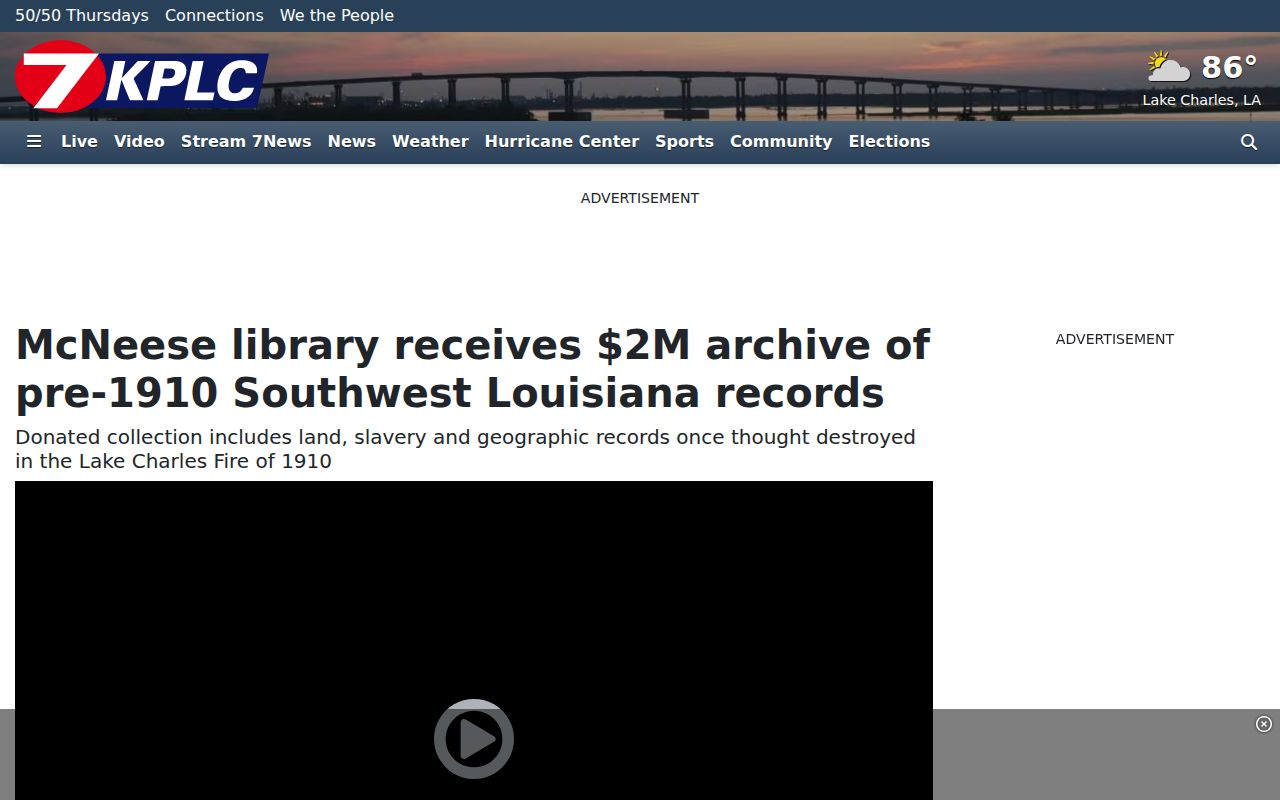
A July 2026 report described McNeese's Loftin-Levingston Title Records collection as a new route into pre-fire history. The material reaches from the 1840s and includes maps, property, cemetery, industry, and slavery records across five parishes. The collection was displayed in June 2026, with an archive target in fall 2026 and a public website target in 2028. Those are dated plans, so verify access before making a trip.
The McNeese Archives and Special Collections provides the institutional access point.
The archive page establishes the repository, while the news report documents the title collection's emerging access timeline.
The July 2026 report on the pre-1910 records is captured below.
Map Calcasieu Previous Addresses
Deeds identify land, not always the age or shape of a building. Planning permits can date construction, additions, demolition, reroofing, and trade work when records are released. A Sanborn fire-insurance map can show building footprints, use, and street context, though an exact official Lake Charles sheet run was not confirmed in the research. Ask the library, McNeese, or Library of Congress catalog for the address and date.
Compare a historic map footprint with the current Calcasieu Parish GIS parcel, the deed date, and any released permit. Utility customer lists were not located as a public directory. Do not substitute a water or power account assumption for occupant evidence.
Calcasieu Previous Resident Endpoints
When a prior owner dies, an obituary may supply relatives, a last known place, and funeral or cemetery clues. The library index is a finding aid, not a certified death record. Preserve the newspaper title, publication date, and image source. Cemetery records can then identify a burial place, while the Louisiana Cemetery Board database supplies cemetery contacts rather than a statewide grave-name search.
The Calcasieu Clerk keeps successions. A case may identify heirs and property filings, and a judgment of possession can reappear in the conveyance chain. Follow the same legal description into the next deed. This closes an ownership transfer without claiming that every heir lived at the house.
Verify Calcasieu Previous Residents
Owners are only half of a house history. A directory may list a person at the address in one publication year, and an open census can show the household on one enumeration date. An obituary, school yearbook, church record, newspaper item, or business listing may add context. None should be stretched beyond its date or field.
Build the final timeline with separate columns for date, person or organization, address wording, source, page or instrument number, and what the record proves. Mark conflicts instead of smoothing them out. Two independent records that agree on the same name, place, and period are stronger than two copied index entries from the same source.
A parcel exemption or mailing address may suggest owner occupancy, but it does not prove who slept at the situs. Likewise, a directory listing may lag a move. Use cautious terms such as “listed at,” “recorded owner,” or “enumerated at” so previous residents are not confused with prior titleholders.
Lawful use. Research Calcasieu Parish previous residents for house history, genealogy, and other lawful personal purposes. Never use the findings to track, stalk, harass, or harm a living person.